Verse is a rocketship propelling the energy industry forward. Explore the UniVerse to see where we’re innovating and building tools that make the energy transition faster, smarter, and more fun.
Verse is a rocketship propelling the energy industry forward. Explore the UniVerse to see where we’re innovating and building tools that make the energy transition faster, smarter, and more fun.
PPA Invoice Validation: How One Clean Energy Buyer Successfully Recovered $500K
Table of contents
How One Clean Energy Buyer Recovered $500K in PPA Overcharges—and Gained Confidence in Their Portfolio
With Verse’s help, this enterprise energy team moved from reactive guesswork to proactive PPA invoice validation—uncovering hundreds of thousands in errors and strengthening developer relationships in the process.
The Problem
Are we overpaying—and is our project underperforming?
… It’s a more common problem than most energy teams want to admit. As vPPA portfolios grow in size and complexity, the gap between what developers invoice and what buyers can verify widens. Without dedicated tools for PPA invoice validation, most teams are left taking invoices at face value—and hoping for the best.
… And it’s the question this enterprise energy manager kept asking. The organization had entered into a virtual power purchase agreement (vPPA) with the promise of long-term savings and clean energy claims. But every month, a new invoice arrived with little transparency—and generation was consistently lower than expected.
The team didn’t have the bandwidth or in-house tools to perform PPA invoice validation, and they lacked insight into why their asset’s performance was trailing forecasts. With limited data access and no easy way to validate the numbers, frustration was building.
The stakes were high. The organization had made a public commitment to clean energy, and leadership expected results. But without visibility into whether their vPPA was performing as contracted, the energy team couldn’t confidently report on cost savings or clean energy claims. Every month that passed without answers was another month of potential overcharges going unrecovered—and another month of uncertainty for a team already stretched thin.
The Verse Solution
Aria’s Portfolio Insights app changed everything. Verse’s team connected the customer’s PPA to Aria, the clean energy platform designed for real-time PPA invoice validation, forecasting, and reporting.
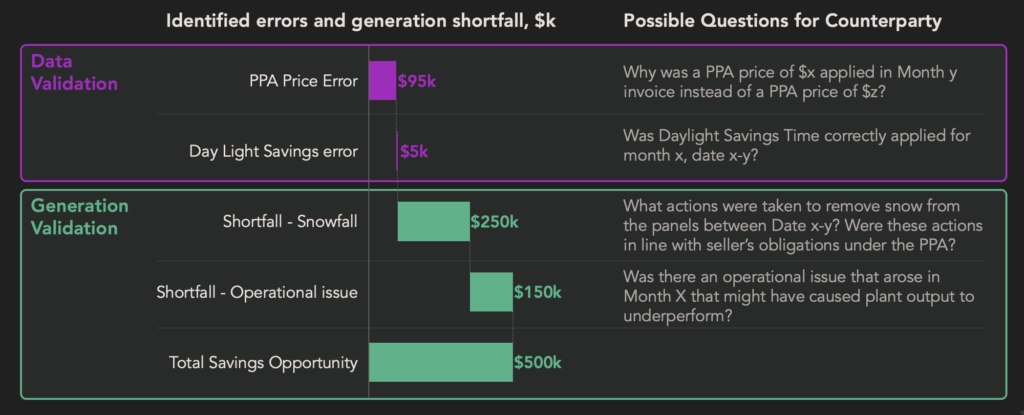
Data Validation: Aria automatically verified contract pricing line-by-line, checking every invoice against the agreed PPA terms.
Generation Modeling: Using both machine learning and physics-based models, Aria recreated what the asset should have produced—based on weather, location, and resource availability.
Anomaly Detection: It flagged errors like incorrect daylight savings adjustments, pricing mismatches, and performance shortfalls following major weather events (like a snowstorm that reduced solar output).
Counterparty Support: Aria even generated templated messages the customer could send directly to the project developer to question discrepancies—with the data to back it up.
Left unchecked, these types of errors compound month over month — quietly eroding the financial case for clean energy procurement and making it harder to defend the program internally. By the time most teams catch a billing discrepancy, they’ve already overpaid.
The Result
$500,000 in cost recovery, including $100K from pricing errors and $400K from generation shortfalls
12 months of PPA invoice validation completed, with clear, auditable reporting
Improved developer communications with faster dispute resolution
Executive-ready insights delivered via dashboards, reports, and APIs
Where the team once spent hours manually cross-checking invoices against PPA contract terms, they now have automated alerts, executive-ready reporting, and a clear audit trail at their fingertips. Finance and sustainability teams finally had the same version of the truth—and the confidence to act on it.
But the biggest outcome?
Confidence. The customer no longer had to guess or hope their invoices were accurate—they had the data, tools, and automated PPA invoice validation to ensure every dollar was accounted for.
That confidence extends beyond the finance team. With Verse’s automated PPA invoice validation in place, the organization can now stand behind its clean energy reporting, hold developers accountable with data, and focus on what matters most—advancing their decarbonization goals rather than chasing down billing errors.