Verse is a rocketship propelling the energy industry forward. Explore the UniVerse to see where we’re innovating and building tools that make the energy transition faster, smarter, and more fun.
Verse is a rocketship propelling the energy industry forward. Explore the UniVerse to see where we’re innovating and building tools that make the energy transition faster, smarter, and more fun.
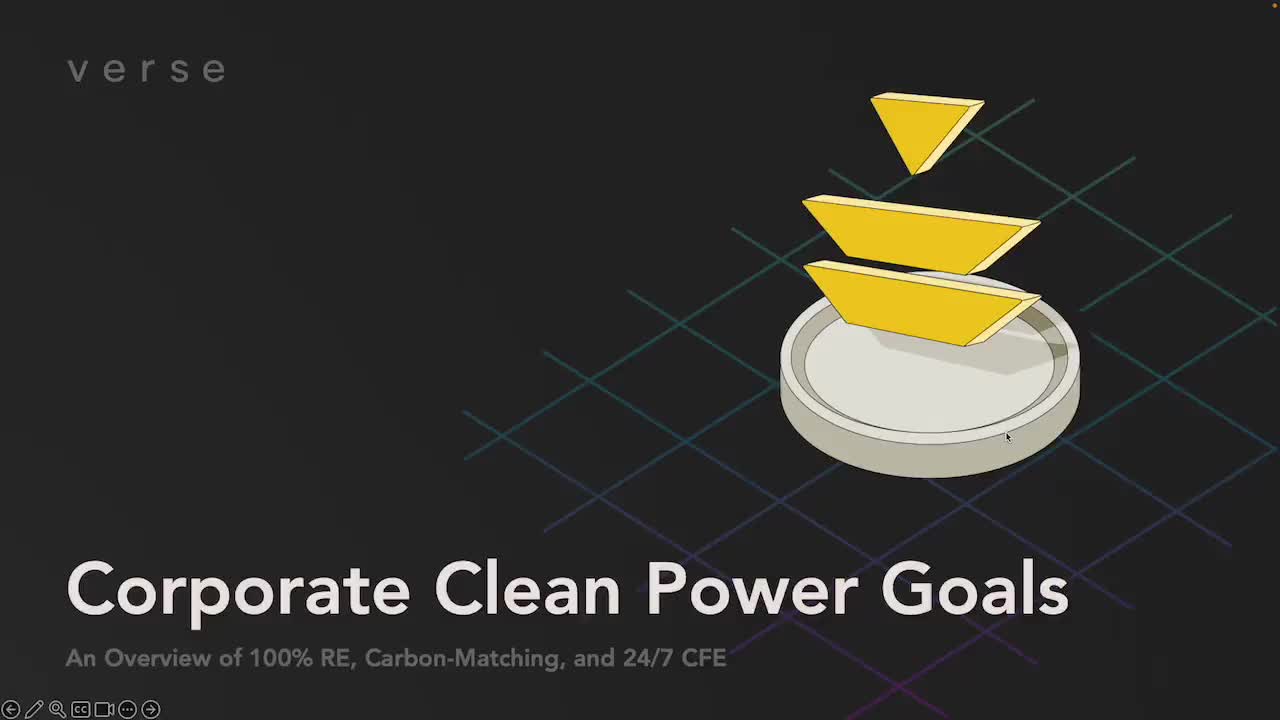
If you’re unfamiliar with Scope 2 decarbonization strategies or need a quick refresher, check out this explainer video! It provides an overview (with examples) of three common strategies, 100% Renewable Energy (RE), Carbon-Matching (aka Emissionality), and 24/7 Carbon-Free Energy (CFE).
Each approach represents a unique way to measure and achieve clean energy goals. But the right choice depends on your company’s geography, budget, and decarbonization ambitions, as well as how you use tools like energy procurement software to analyze cost and impact tradeoffs.
Why Clean Power Matters Now
Today’s enterprise energy decisions are about much more than sustainability branding, they’re about financial resilience, compliance, and competitive advantage. Across sectors, data center operators, manufacturers, and corporate energy buyers are facing three converging pressures:
1. Environmental Responsibility
Organizations worldwide are committing to net-zero emissions, and Scope 2 (purchased electricity) represents one of the most direct levers for impact. As more companies measure and disclose emissions, procurement leaders are prioritizing clean energy contracts to meet internal and public climate goals.
2. Regulatory Compliance
Emerging disclosure frameworks like the SEC’s climate reporting rules, California’s SB 253, and the EU’s CSRD all require transparent reporting on Scope 2 emissions. Companies must be able to demonstrate how their energy procurement decisions align with emissions reduction strategies, and ensure those claims are supported by auditable data.
3. Energy Volatility & Financial Health
Clean energy isn’t just about sustainability anymore, it’s a financial hedge. Long-term Power Purchase Agreements (PPAs) and Virtual PPAs (VPPAs) can protect organizations from price volatility while helping them achieve emissions goals. Understanding how each decarbonization strategy performs across markets and time horizons is essential for balancing cost and carbon.
4. Customer & Investor Expectations
Corporate buyers, partners, and customers increasingly expect proof of progress. Aligning your procurement strategy with credible Scope 2 reductions builds trust, enhances ESG scores, and strengthens your position with investors and regulators alike.
Decarbonization Strategy #1: 100% Renewable Energy (RE)
The 100% Renewable Energy (RE) approach focuses on matching a company’s annual power consumption with an equal amount of clean energy generation.
For example, if Company A uses 100,000 MWh of electricity between January 1 and December 31, it will procure 100,000 MWh of renewable energy over that same period.
This strategy is simple and cost-effective, but it’s also location-agnostic. That means a company can purchase renewable energy wherever it’s cheapest, regardless of where its operations consume power.
Example: A company headquartered in Louisiana could buy renewable energy from projects in Texas or the Midwest to offset its annual consumption.
This flexibility makes 100% RE attractive for cost-conscious organizations. However, it does not necessarily guarantee carbon reductions in the same grid where consumption occurs, a critical limitation for companies aiming for localized impact or regulatory compliance.
Carbon-Matching, also known as Emissionality, shifts the focus from energy quantity to emissions quality.
Here, the goal is to match a company’s annual carbon emissions (from purchased electricity) with an equivalent amount of avoided emissions through clean energy purchases.
If Company A emits 40,000 tons of CO₂ in a year, it would procure renewable energy that avoids 40,000 tons of emissions over the same timeframe.
Unlike 100% RE, carbon-matching prioritizes impact over proximity, but location still matters. Each electricity grid has a different carbon intensity, meaning the same solar MWh can displace more emissions in one region than another.
Example: A company pursuing carbon-matching would prefer to buy solar power from Kentucky’s fossil-heavy grid rather than California’s, where carbon intensity is lower due to abundant clean generation.
Carbon-matching helps companies optimize for maximum emissions impact per dollar spent, but requires robust modeling to identify the right markets and assets, a task that’s best supported by tools like Verse’s energy procurement software and risk modeling platform.
Decarbonization Strategy #3: 24/7 Carbon-Free Energy (CFE)
The most advanced approach, 24/7 Carbon-Free Energy (CFE), aims to match every megawatt-hour (MWh) of electricity consumption, every hour of every day, with carbon-free energy from the same grid.
This hourly, location-specific strategy represents the end state of a decarbonized energy system. A company that meets all its hourly demand with local, carbon-free generation achieves a CFE score of 100%.
Unlike annualized strategies, 24/7 CFE demands real-time visibility and forecasting precision. Enterprises pursuing this approach often rely on advanced modeling and scenario planning tools, such as Verse’s energy forecasting platform, to evaluate when and where clean energy supply aligns with consumption.
The benefits are clear:
Transparent, credible decarbonization progress
Stronger regulatory and investor alignment
Improved risk control and data integrity
However, it’s also the most resource-intensive path, requiring deep partnerships, technology integration, and long-term procurement planning.
Which Strategy Is Right for You?
Choosing the right Scope 2 strategy isn’t a one-size-fits-all decision. Each approach offers tradeoffs between cost, emissions impact, data precision, and complexity.
That’s where Verse comes in.
Verse’s Aria platform enables companies to model and compare each strategy’s implications / from 100% RE to Carbon-Matching to 24/7 CFE, by analyzing cost, risk, emissions, and carbon-free energy profiles side by side.
With Aria, you can:
Simulate scenarios and compare contract outcomes
Visualize portfolio risk under multiple market conditions
Forecast long-term carbon and financial performance
Build precise procurement roadmaps tailored to your goals
Whether you’re exploring renewable energy tariffs, evaluating PPA vs VPPA options, or defining a pathway to 24/7 carbon-free energy, Verse’s data-driven insights help you make smarter, faster, and more confident clean energy decisions.
Conclusion: From Targets to Tangible Impact
Every organization’s Scope 2 journey starts with the same question: What’s the best way to buy clean energy?
The answer depends on your priorities, cost, impact, transparency, or operational simplicity. But with the right strategy and intelligent modeling tools, you can pursue decarbonization that’s both financially sound and scientifically credible.
Verse’s mission is to make that process seamless, transforming how enterprises plan, procure, and verify clean energy at scale.
Ready to see which decarbonization strategy fits your roadmap?
Talk to our team or explore our procurement platform to start modeling your clean energy options today.