


Energy Billing Validation, Settlements, and Contract Adherence Analytics

Most organizations treat energy billing validation as something that happens after an invoice is sent through, assuming the financial outcome is final and it’s time to pay. In reality, settlement often marks the point where financial exposure becomes fixed—not where confidence is actually established.
Energy billing validation is typically treated as a downstream accounting task: review the invoice, reconcile totals, approve for payment. But for long-term power purchase agreements, invoice validation sits at the intersection of performance, pricing, and contractual obligation. When it’s handled reactively, small discrepancies accumulate quietly, month after month, without triggering alarms.
Costly PPA invoice issues can easily slip through the cracks. There’s a chance that they surface later: during accrual true-ups, audits, contract disputes, or executive reviews where no one can fully explain why outcomes diverged from expectations … or they go forever unnoticed.
This page exists to reframe that reality and how organizations approach energy billing validation.
PPA invoice validation, energy settlements, and contract adherence are not clerical cleanup activities. They are ongoing governance and risk visibility functions that determine whether organizations are actually capturing the value they contracted for or slowly giving it away.
Why Energy Billing Validation Is More Than an Accounting Task
At a surface level, energy billing validation looks like accounting work. Invoices arrive. Volumes and prices are reviewed. Rows and columns are tallied. Payments are made.
But that framing misses what actually needs to be validated.
In a PPA, the invoice is the financial expression of operational performance against contract terms. Validating it correctly requires answering questions that sit well beyond accounts payable:
- Did the asset operator perform as contracted?
- Were volumes delivered as expected and if not, why?
- Were pricing mechanisms applied correctly ?
- Did outages, curtailment, or availability issues trigger contractual consequences?
- Are we paying for energy outcomes we didn’t actually receive?
These are not accounting questions—they are central to effective energy billing validation. When invoice validation is treated purely as an accounting check, teams focus on arithmetic consistency rather than contractual correctness. The result is a false sense of confidence: the invoice matches expectations on paper, but not necessarily in substance.
Effective energy billing validation function as:
- Performance verification, confirming that physical outcomes align with commercial assumptions
- Contract enforcement, ensuring that pricing, guarantees, and remedies are actually applied
- Financial risk control, preventing silent errors that can compound across settlement periods
Finance leaders often carry accountability for invoice approval and accrual accuracy, while energy and sustainability teams carry accountability for performance and counterparty relationships. When validation is narrowly scoped, neither group has full visibility and gaps emerge between responsibility and control.
How Energy Settlements Actually Introduce Risk

Settlement data often arrives many weeks after generation occurs, reflecting the complexity of electricity market settlement processes. During that lag:
- Volumes may be revised
- Pricing components may be adjusted
- Curtailment classifications may change
- Market or counterparty corrections may be applied
By the time invoices are issued, teams are reconciling past events, not actively monitoring exposure as it develops.
This dynamic creates several risk conditions:
- Lagged visibility: Issues emerge after the period is settled
- Compressed review windows: Validation happens under time pressure, not analytical rigor
- False finality: Settlement is mistaken for correctness rather than just completion
In direct energy settlement arrangements, where counterparties manage settlement mechanics, organizations are often even further removed from underlying assumptions. Without independent validation, teams rely on trust rather than verification, a fragile position when contract economics are complex.
Settlement doesn’t eliminate risk. It often masks it, especially when energy billing validation happens after the fact until correction becomes difficult, contentious, or reputationally sensitive.
Where PPA Settlement Errors Quietly Accumulate
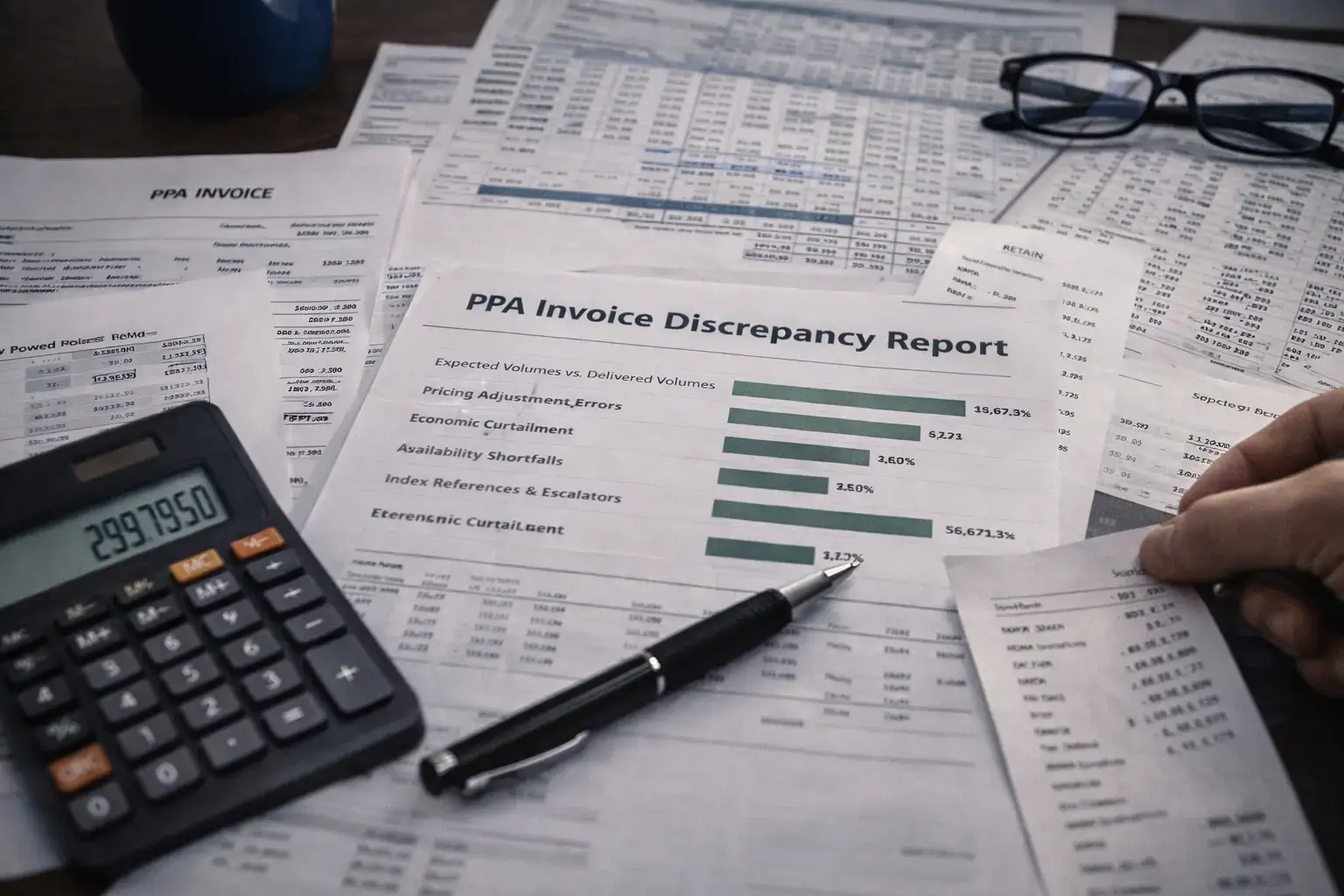
Material mistakes in PPA settlements (often missed in energy billing validation) rarely come from a single obvious error. They can accumulate through small, recurring discrepancies that don’t trigger immediate action.
Common risk categories include:
Volume discrepancies
Differences between expected and delivered volumes, especially when driven by energy asset operational decisions, can materially affect outcomes over time.
Pricing adjustments
Escalators, index references, and formula-driven pricing elements evolve across contract years. Small misapplications can compound silently.
Economic curtailment
Curtailment events often carry nuanced treatment. Misclassification or under-recognition of curtailment can lead to missing claimable value.
Availability guarantees
Performance thresholds tied to availability or output are easy to overlook without continuous monitoring, particularly when shortfalls don’t immediately breach dramatic thresholds.
Price floors, caps, and collars
These mechanisms are designed to manage risk, but only if they’re actively enforced. Without visibility, organizations may absorb downside while failing to capture upside protections.
Basis differentials
Location-based pricing differences introduce subtle exposure, especially when settlement references shift over time.
Individually insignificant, these discrepancies compound and are where value is lost simply through a lack of oversight.
Contract Adherence Is Performance Analytics, Not Legal Cleanup
Contract adherence is often framed as something that happens after something goes wrong: a dispute arises, a claim is filed, legal gets involved.
That framing is backward.
Contract adherence in PPAs is fundamentally about ongoing performance visibility and effective energy billing validation. It requires understanding how real-world operational outcomes map to commercial obligations continuously (not retrospectively).
Key contract-driven performance areas include:
- Outages that affect availability or delivery commitments
- Curtailment events with economic consequences
- Liquidated damages triggered by defined underperformance
- Performance guarantees tied to output, efficiency, or uptime
When these elements aren’t monitored proactively, organizations miss two things at once:
- Risk signals that exposure is accumulating
- Value opportunities embedded in contractual protections
Missed clauses don’t just create downside risk. They represent missed value that was explicitly negotiated but never realized.
Contract adherence analytics reframes enforcement from reactive claims management to ongoing assurance that agreements are operating as intended.
Why Issues Are Discovered After Payment, Not Before
If PPA invoice issues are so common, why do they so often surface after payment?
The answer isn’t negligence. It’s structure.
Several systemic factors push discovery downstream:
Settlement timing
By the time data are finalized, invoice payment is already in motion.
Lack of early alerts
Without signals tied to performance and contract logic, discrepancies remain invisible until they appear (sometimes) in post-mortem analysis.
Fragmented ownership
Finance owns payment. Energy teams own performance. Legal owns contracts. Sustainability owns EACs. No single function owns end-to-end correctness.
The result is a familiar pattern: confidence at approval, discomfort at review, and defensiveness during explanation.
How Leading Teams Think About Invoice and Contract Risk Differently
Organizations with mature PPA portfolio management don’t eliminate complexity. They surface it earlier.
At a high level, these teams share several characteristics:
- Validation happens before payment, not as a post-settlement audit
- Performance is evaluated against contract logic, not just operational metrics
- Claimable events are identified early, while remediation is still practical
- All teams involved share visibility, rather than passing issues downstream
This isn’t about adding process. It’s about aligning financial outcomes with contractual intent continuously.
Energy Billing Validation as an Executive Governance Signal
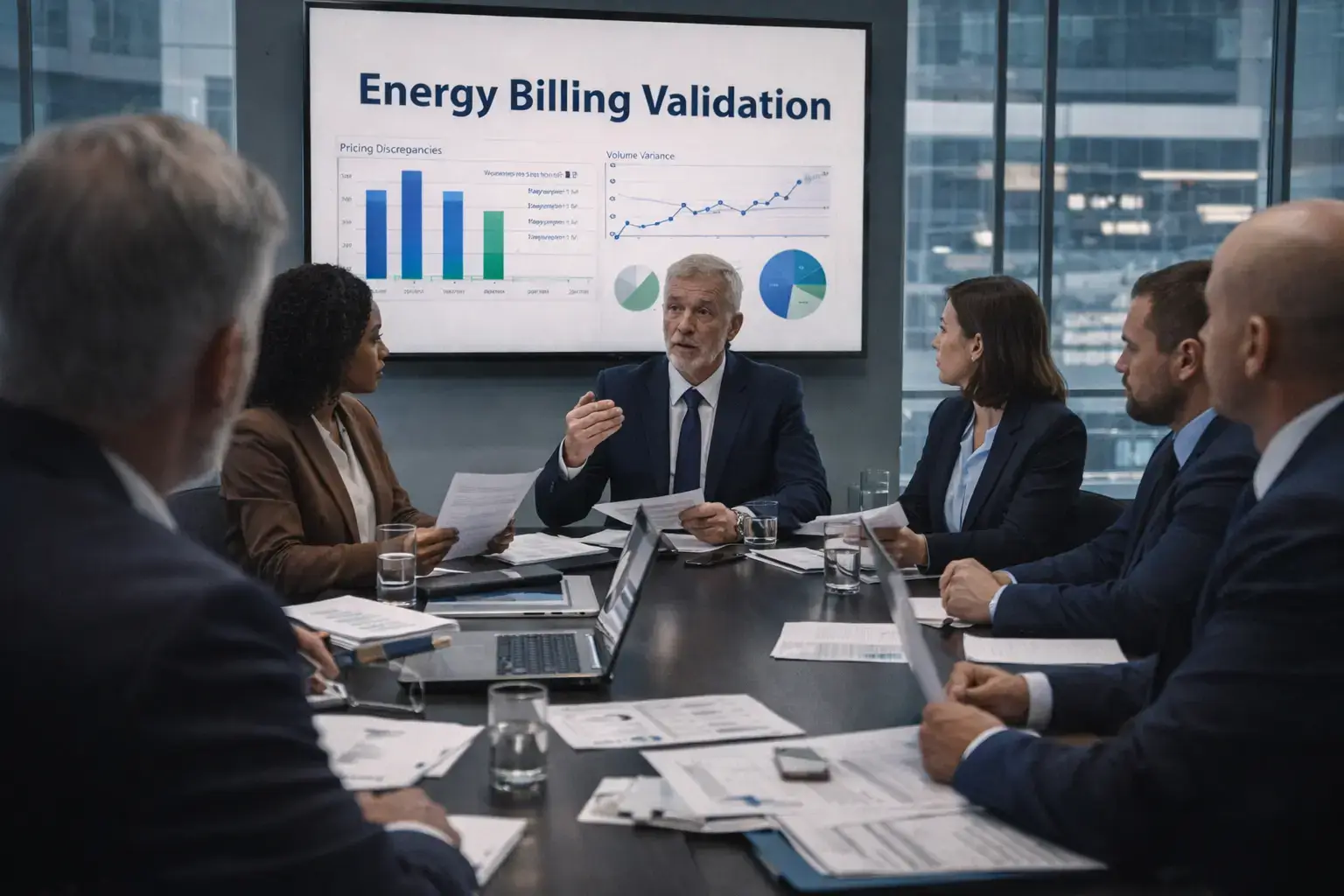
When organizations struggle to explain settlement outcomes, several questions naturally follow:
- Where is accountability for contract enforcement?
- How confident are we in reported financials tied to long-term agreements?
- What risks are we carrying that won’t surface until audit or renewal?
- Are we relying too heavily on counterparties to self-report correctness?
The financial impact is often invisible at the executive level precisely because it doesn’t show up as a single dramatic failure. It appears as:
- Unexplained accrual adjustments
- Repeated true-ups
- Post-period corrections
- Low-confidence answers in board or audit settings
Over time, this erodes trust, not just in the numbers, but in the organization’s ability to govern complex commercial relationships.
Energy billing validation, settlements, and contract adherence are therefore not operational details. They are indicators of how well the organization controls risk in one of its most material long-term commitments.
Assessing Your Exposure to Energy Billing Validation and Contract Risk
If invoice discrepancies, settlement questions, or contract debates feel like recurring surprises, it’s often because exposure is accumulating outside the line of sight until it becomes unavoidable.
Key signals of unseen risk include:
- Confidence based on settlement completion rather than validation
- Heavy reliance on counterparties for correctness
- Discovery of issues only after payment or audit
- Difficulty explaining variance drivers across teams
Understanding where value loss could occur is the first step toward improving energy billing validation.