

Matt Barnes
Chief Commercial Officer | Calibrant Energy

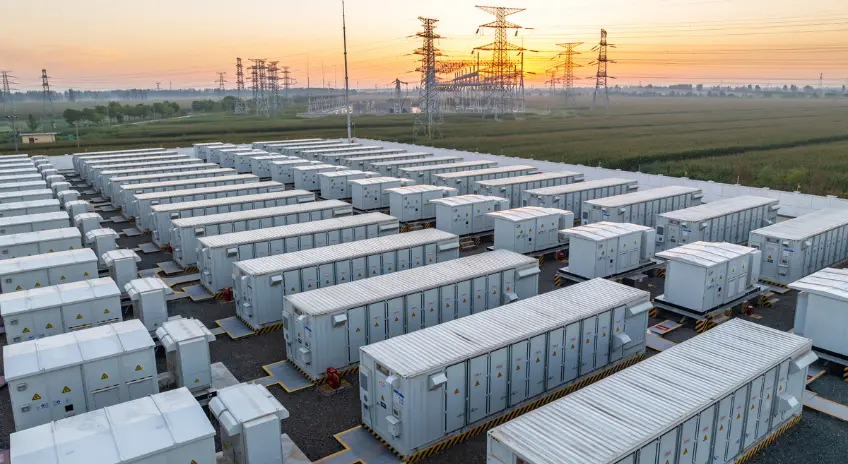
Batteries aren’t just for backup anymore—they’re a competitive advantage. Battery energy storage has moved from a safety measure to a strategic asset, helping enterprises navigate volatile markets, rising costs, and interconnection.
In this webinar, you’ll hear how corporate leaders are deploying battery energy storage, solar, and advanced controls not only to cut costs and boost resilience, but also to drive sustainability and long-term business value. You’ll also learn how AI-powered planning and optimization tools are transforming battery energy storage into a driver of ongoing financial and operational performance.
In this hour-long webinar, you’ll learn…

Matt Barnes
Chief Commercial Officer | Calibrant Energy
Matt Barnes is the Chief Commercial Officer at Calibrant Energy, where he leads the company’s commercial strategy, business and market development, and partnership efforts. With over 15 years of experience in the clean energy sector, Matt oversees Calibrant’s go-to-market approach across key segments including commercial, industrial, and data center verticals. Before joining Calibrant, Matt held leadership roles in demand response and distributed energy solutions at EnerNOC and Enel, focusing on advancing decarbonization through innovative financing and technology-agnostic approaches. He is passionate about helping organizations accelerate their energy transition and unlock their growth objectives by delivering reliable, cost-effective, and sustainable on-site energy solutions.

Shehzad Wadalawala
VP, Strategy | Verse
Shehzad is a wholesale energy market expert with 15+ years of experience developing and implementing strategies for buyers of electricity that balance forecasted cost, sustainability goals, financial risk, and operational efficiency. He was responsible for developing and implementing Google’s Energy Hedging Program and Risk Management Framework for its global energy portfolio of data centers and energy supply.
Shehzad has led and executed energy portfolio management and hedging programs for a range of organizations, including municipalities, educational institutions, utilities, and community choice aggregators. His background offers a holistic view of U.S. energy markets, combining utility experience (managing reliability and ensuring regulatory compliance with state- and ISO-level energy procurement rules) and advanced private-sector energy procurement.
Katie Ryan: Welcome everyone. I’m Katie Ryan, VP of Sustainability at Trellis, and I’m thrilled to welcome you to today’s webinar: From Storage to Strategy — How AI, Batteries, and Solar Unlock Sustainable Business Value. This session is being recorded, and slides and the recording will be shared with all registered attendees. Please use the Q&A box throughout — we’ll address questions in real time and at the end of the session.
Katie Ryan: Let me introduce our speakers. Shehzad Wadalawala is VP of Strategy at Verse, which uses AI to make real-time energy data analysis possible — helping organizations plan, procure, and manage clean energy. Matt Barnes is Chief Commercial Officer at Calibrant Energy, which develops large-scale on-site solar and battery storage solutions for major power users.
Shehzad Wadalawala: Really excited to be here. What’s old is new again — distributed energy resources are having a major revival, especially with the role battery energy storage is playing. Great time to be talking about this.
Matt Barnes: Thanks, Katie and Shazad. Storage has come a long way even in just the last few years. It’s more approachable and more impactful than it’s ever been, and I’m looking forward to getting into the specifics today.
Shehzad Wadalawala: Let’s start by setting the stage for why storage has become so important at this particular moment. The first factor is demand growth. ICF forecasts that U.S. electricity demand will grow 25% by 2030 and 78% by 2050. After roughly two decades of essentially flat load across the developed world — where utilities were actually seeking out new load from Bitcoin operators and EV charging just to distribute infrastructure costs — we’re now looking at a steep upward trajectory that the grid was not designed to handle.
Shehzad Wadalawala: An important nuance: peak demand is projected to grow 14% by 2030 and 54% by 2050 — meaningfully slower than total energy demand. That gap creates a real opportunity around peak management. If we can shift consumption to times when infrastructure is available, battery energy storage becomes a key enabler of a more efficient and cost-effective grid.
Shehzad Wadalawala: While data centers and AI get most of the headlines, industrial electrification — transport, buildings, manufacturing processes — is also a significant driver. The original policy premise was that electrifying industry would be clean because the grid would increasingly run on renewables. That’s still the direction, but the pace of load growth has outrun the pace of infrastructure build-out.
Shehzad Wadalawala: On the generation side, solar is the primary engine of new capacity. It is the most cost-effective and fastest-to-build resource. Battery energy storage is the second-fastest to deploy and is needed to integrate solar effectively — shifting generation to hours when demand is highest. Natural gas will continue to play a role in providing flexibility during this transition, though its role is expected to diminish over time as storage capacity grows. Wind and nuclear will also contribute, but face longer lead times. For nuclear specifically, we’re unlikely to see material new capacity until the 2030s.
Shehzad Wadalawala: One more important data point: under the One Big Beautiful Bill, while tax credits for solar and wind are being phased out, battery energy storage incentives remain in place. That’s an acknowledgment that storage is essential to grid reliability as renewable penetration grows. There are Foreign Entity of Concern supply chain considerations that affect batteries as well — so any storage procurement needs to account for those compliance requirements — but the headline is that battery energy storage retains its incentive structure where solar and wind do not.
Shehzad Wadalawala:Battery energy storage can do a remarkable number of things, which is both exciting and a little daunting. The Rocky Mountain Institute has a well-known diagram that maps the full range of storage applications across three broad categories: customer-sited services, wholesale market participation through ISOs, and utility system services like transmission deferral. The breadth of what storage can do is one of its superpowers — and one of the reasons it can feel complex to evaluate.
Matt Barnes: That complexity is exactly why Calibrant exists. Our customers don’t come to us asking for a battery — they come with business problems. Those typically fall into three categories. The first is cost reduction: lowering utility bills through demand charge management, time-of-use optimization, or coincident peak avoidance. The second is resilience: ensuring operations can continue through grid outages or extreme weather events, and increasingly, protecting against economic volatility when power prices spike unexpectedly. The third is speed to power: as large industrials and data centers race to expand capacity, utility connection timelines of five to seven years are simply incompatible with business objectives. Battery energy storage has become a tool for unlocking grid access years ahead of what would otherwise be possible.
Matt Barnes: The right balance of those priorities is different for every organization. Some put cost first. Some are in geographies where resilience is paramount. Others are racing to connect new load. We help partners identify which levers matter most for their specific situation and design a solution that maximizes value across all three — without requiring them to become storage experts themselves.
Shehzad Wadalawala: Verse supports corporate buyers in achieving both sustainability and cost goals — from planning and procurement through ongoing operations. Battery energy storage is increasingly central to both. Here are two examples of how we’ve supported storage analysis for clients.
Shehzad Wadalawala: The first was a utility-scale, front-of-the-meter project where a client wanted to evaluate battery energy storage as part of a broader portfolio strategy — specifically around financial risk management. We used a value-at-risk framework to quantify uncertainty in cost outcomes and modeled how different battery energy storage configurations would interact with the client’s existing renewable portfolio. The goal wasn’t just to evaluate storage in isolation but to understand how it created value — or reduced risk — at the portfolio level. We were able to rapidly identify which projects had the best opportunity to meet their objectives at the lowest cost, and presented the results as a revenue stack showing contributions from ancillary services, capacity, and energy arbitrage. The process was a significant improvement over the consultant-and-spreadsheet workflow they had used previously.
Shehzad Wadalawala: The second was a behind-the-meter assessment for a company with over 120 sites. They wanted to identify where on-site distributed energy resources — including battery energy storage and cogeneration — made the most economic sense, without evaluating each site one at a time. We built a flexible model that captured site-specific tariff structures, time-of-use rates, wholesale energy arbitrage opportunities, coincident peak charges, and reliability benefits tied to potential lost revenue from outages. The analysis surfaced sites with battery energy storage IRRs around 7% and identified significant co-generation savings opportunities as well. Rather than drowning in a site-by-site exercise, the client got a prioritized map of where to act first.
Matt Barnes: I want to walk through three projects that each illustrate one of the core value drivers I mentioned earlier.
Matt Barnes: The first is a microgrid we developed for Eaton in Puerto Rico. Following Hurricane Maria in 2017, Eaton’s manufacturing facility — a critical node in their global supply chain — was offline for weeks due to prolonged grid outages. That event made the resilience need impossible to ignore. We worked with Eaton to develop what is now the largest clean energy microgrid on the island: approximately 5 megawatts of solar paired with about 1 megawatt of battery energy storage, with fossil backup for extended outages. The system provides more than half of the facility’s annual electricity consumption from solar, reduces annual GHG emissions by more than 4,000 metric tons, and significantly reduces dependence on diesel during outages when fuel supply chains on the island are constrained. Critically, Eaton deployed no upfront capital. Because power costs in Puerto Rico are high, the project delivered resilience and sustainability at below-grid-parity pricing. Calibrant owns and manages the system entirely.
Matt Barnes: The second project is with Imperial Oil in Ontario, Canada, and is focused entirely on cost reduction. At the time of installation, it was the largest behind-the-meter battery energy storage project in North America. Ontario has a large infrastructure cost component in commercial power bills called the Global Adjustment charge, which is allocated based on a customer’s coincident peak consumption — meaning how much power you draw during the system’s peak hours, typically hot summer afternoons or cold winter mornings. By predicting those peak windows and discharging stored energy to reduce apparent grid consumption during those periods, Imperial Oil reduces its allocation of those infrastructure costs while also helping to relieve strain on the local grid. This project is also fully owned and operated by Calibrant on a benefit-sharing basis, so Imperial Oil and Calibrant share in the savings — creating aligned long-term incentives over the 15-to-20-year agreement.
Matt Barnes: The third project may be the most timely. It addresses the grid connection challenge facing data centers. One of the largest data center operators, Aligned, needed grid capacity that their local utility, Portland General, could not deliver for five to seven years. We worked with Aligned and the utility to identify the specific constraint driving that delay and designed a 31-megawatt, 62-megawatt-hour battery energy storage system that synthetically alleviates that constraint — enabling Aligned to connect to the grid years ahead of schedule. This translates directly to hundreds of millions of dollars in annual revenues that would otherwise have been inaccessible. The solution does not shift any cost to other ratepayers. It is fully funded by Calibrant and Aligned, and it actually improves grid utilization efficiency for existing customers. From first conversation to equipment procurement was six months. Total project timeline to completion is under two years — a meaningful contrast to the five-to-seven-year utility queue. The project uses domestically manufactured equipment including transformers, switchgear, and batteries.
Matt Barnes: None of these started with a customer asking for a battery. They all started with a business problem. That’s the pattern across everything we do — the technology is the solution, not the starting point.
Katie Ryan: Resilience kept coming up in our audience word cloud at the start of the session. It seems to mean different things to different people. How do you each think about it when a customer comes to you with that word?
Shehzad Wadalawala: There are two dimensions. The first is financial resilience — the ability to respond to market signals, manage consumption flexibly, and avoid unexpected cost spikes. For large organizations with significant energy spend, that can be material. The second is operational resilience — ensuring that critical systems stay online. For hyperscalers and large data centers, even brief outages make news. Both matter, and battery energy storage can address both.
Matt Barnes: I’d add a third dimension that’s getting more attention: economic resilience at the community level. As severe weather events increase, we’re seeing power bill spikes that can catch organizations off guard even when their lights stay on. Battery energy storage can buffer against that economic volatility. Beyond that, I think large power users have a genuine obligation to be good grid citizens — to deploy assets that help support grid reliability during its most challenging moments, not just consume from it. That obligation may not always be the primary selling point internally, but it’s worth naming. And in some jurisdictions, like Ireland, regulators have already begun to mandate grid-responsive behavior from large industrial loads. Organizations that get ahead of that now will be better positioned when similar requirements arrive in the U.S.
Katie Ryan: Speaking of getting things through internally — who are the stakeholders that need to be aligned for these projects to move forward?
Matt Barnes: Internally, you need your finance leadership, engineering and technical teams, the plant or facilities manager, and your CFO’s office. Each will ask different questions — financial teams want the business case; technical teams want to understand integration; operations teams need to understand day-to-day impact. Externally, the utility is a critical partner — most of these projects require some level of formal engagement or bilateral discussion with the utility. And there’s standard permitting and zoning involved as with any construction project. Looking longer term, the community conversation matters too, especially as load growth from large industrials and data centers creates real tension around infrastructure costs for other ratepayers.
Shehzad Wadalawala: The dynamic with utilities has shifted significantly. When I was at PG&E early in my career, utilities wanted load — they were rolling out the red carpet for data centers because more load meant more revenue and more justification for infrastructure investment. That’s changed. Now utilities are under pressure from regulators and existing customers to ensure that new large loads aren’t increasing costs for everyone else. Coming to those conversations with a credible supply solution — especially one that includes battery energy storage — changes the tone entirely. Without battery energy storage, utilities often respond to solar-only proposals by pointing to the reliability gap and the need to build natural gas. Battery energy storage addresses that gap. It’s now a prerequisite, not a premium, in many utility conversations.
Katie Ryan: These are 10-to-20-year agreements. How do you ensure the partnership stays equitable and valuable over a timeframe when everything will change?
Matt Barnes: It starts with engineering. We’ve seen earlier-generation solar and battery energy storage projects that claimed 20-year lifespans but were underperforming within three or four years. We’re rigorous about designing with equipment that will actually deliver over the contract term. Commercially, it comes down to aligned incentives. These aren’t transactions where one side wins and one side loses. The benefit-sharing structures we use mean Calibrant and our partners both do better when more value is generated. And when new programs or market opportunities emerge — and they will — we’re designed to share in those together rather than fight over who benefits. I always say: if you could guarantee what every market program and utility tariff will look like over the next 20 years, you wouldn’t need a partner like us. The partnership exists precisely because things will change.
Shehzad Wadalawala: We don’t believe in point forecasts. The honest answer is that no one can tell you with certainty what energy markets will look like in 20 years. Our approach is to model a realistic range of outcomes, build scenarios, and help clients develop plans that are robust across different eventualities rather than optimized for a single assumption. On the negotiation side, the right posture right now is empathy — recognizing that laws are changing mid-negotiation, that risk needs to be allocated to whoever is best equipped to manage it, and that the goal is a long-term working relationship with your counterparty, not a transaction you can walk away from. Starting from a place of trust means that when something does change — and it will — you’re renegotiating from a foundation of good faith rather than fighting over contract language.
Katie Ryan: For anyone on this call who sees battery energy storage in their future — whether they’re just starting out or adding battery energy storage to an existing program — what’s the one conversation you’d encourage them to have, and who is it with?
Shehzad Wadalawala: Know your why and know your decision-maker. Is sustainability driving this? Cost reduction? Grid reliability? Battery energy storage can serve all three goals depending on how you frame the conversation. The answer shapes everything — who you bring the idea to, how you frame the analysis, who you engage as partners. If your decision-maker is focused on cost savings, that’s a very different conversation than one whose primary concern is being a responsible grid citizen. Get clarity on that first, and the rest of the process becomes much smoother.
Matt Barnes: I’d say start one step before that. Before you write a single email to a vendor or consultant, send a note to your CFO or plant manager that says: ‘If I could help solve [insert specific business challenge — our power costs, last week’s outage, our inability to connect new load on schedule], would that be worth exploring?’ You don’t need to know the solution yet. You just need to know whether leadership sees the problem as worth solving. If the answer is yes, then you have the mandate to dig in — and that’s when you start calling us.
Katie Ryan: This was genuinely both informative and enjoyable — thank you both for bringing your expertise and candor to the conversation. Slides and the recording will be shared with all registered attendees. If we didn’t get to your question today, the Verse team will follow up directly. Thank you everyone for joining.
Shehzad Wadalawala: Thanks, Katie. Great conversation.
Matt Barnes: Thank you both. Thanks, everyone.