


Verse
Blog
5 Reasons Renewable Energy Asset Management Software Beats Spreadsheets

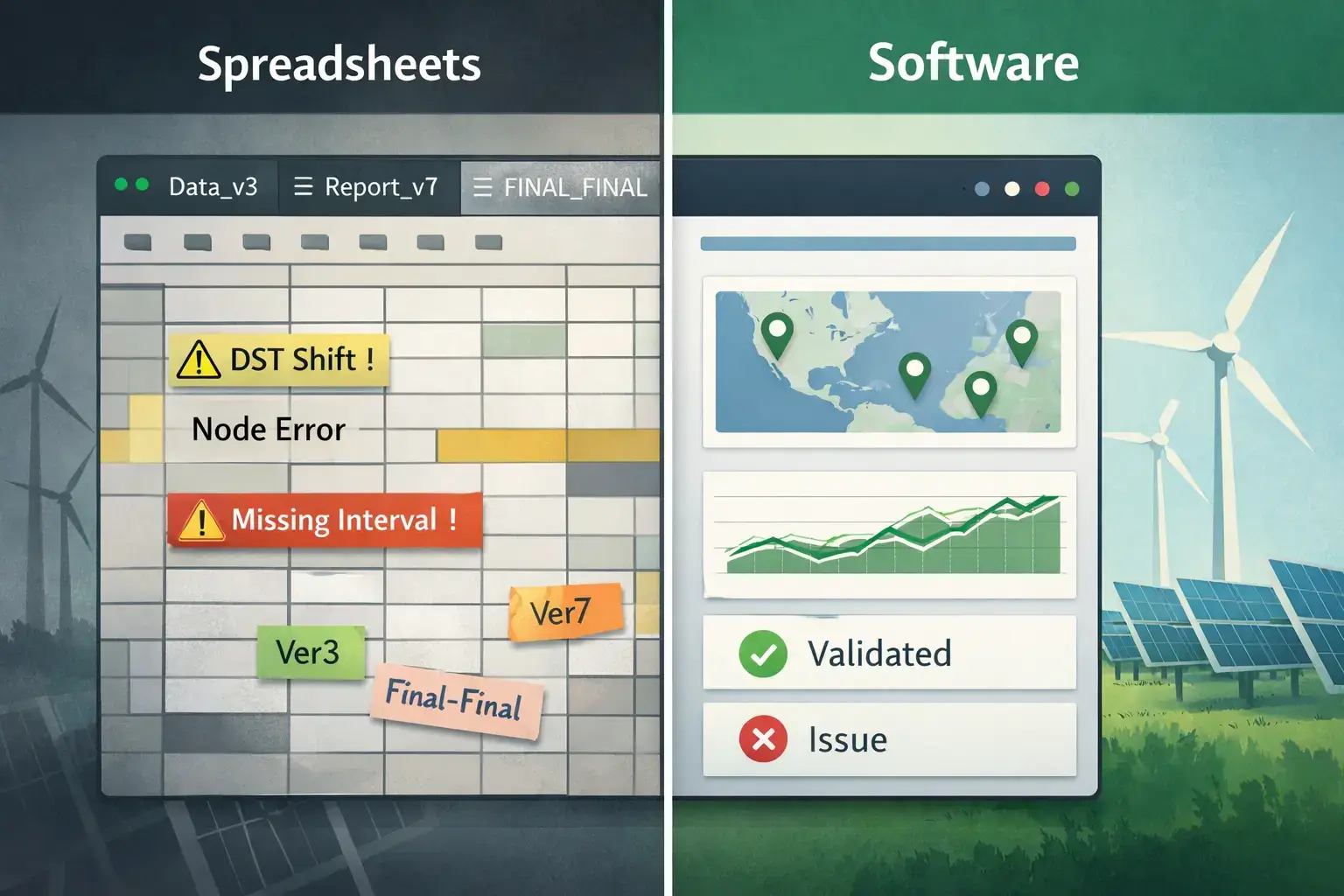
Table of contents
Renewable energy asset management software beats spreadsheets because renewable portfolios create too many ways for small data issues to become real financial variance.
Most teams do not choose spreadsheets because they love them. They choose them because the work shows up faster than systems do.
A contract gets signed. Leadership wants a view of expected value. Finance needs accruals. Operations wants to know whether the plant is doing what it said it would do. Someone builds a workbook, then another workbook, then a “final” workbook that becomes business critical.
The assumption is that if the spreadsheet is detailed enough, it will stay trustworthy.
That assumption breaks down the first time the market moves hard, a timestamp shifts by an hour, or the organization realizes it is running a multi-million dollar process on version control and institutional memory. This is where most teams get stuck. They are trying to run modern management of renewable energy with tools built for static reporting.
Below are five reasons renewable energy asset management software consistently outperforms spreadsheets for asset management, especially once you have more than a handful of renewable energy assets.
1) Validation stops being optional once dollars are moving
Spreadsheets are good at storing numbers. They are not good at proving those numbers are correct. Renewable energy asset management software is built around that distinction.
In practice, many of the highest-impact issues are unglamorous:
- Daylight savings time misalignment that shifts intervals and settlement pricing.
- Pricing mapped to the wrong node or hub for a given contract.
- Missing intervals and missing generation data.
- Subtle formula drift over time as new tabs get added.
All those issues can flow straight into financial reporting and accruals, and then into leadership narratives about whether a portfolio is “performing.”
Yes, a disciplined analyst can catch these in Excel. The problem is scale and repeatability. As portfolios grow, you need validation to be a standard workflow, not a monthly fire drill.
That’s a core advantage of renewable energy asset management software: it turns invoice and settlement checks into a repeatable and automated control. No other renewable energy asset management software feature delivers more immediate ROI. It also creates an audit trail. When finance asks why accruals moved, you can point to what changed instead of re-litigating which spreadsheet was updated.
2) Real-time visibility changes outcomes, not just reporting
Many teams still operate on a monthly or even quarterly cadence. By the time issues surface, the month is closed, the spend is booked, and the organization is explaining variance after the fact.
But renewables do not behave on quarter boundaries. Markets do not either.
When you can see performance developing in near real time, you can adjust before it becomes a surprise:
- Update accrual expectations mid-month.
- Flag a likely invoice discrepancy before the counterparty sends it.
- Communicate internally before leadership asks why spend is off plan.
This is not “monitoring control” for its own sake. It is operational discipline that prevents surprises. In a spreadsheet environment, real-time workflows don’t exist.
Renewable energy asset management software supports a tighter operating cadence because the information is centralized and refreshed automatically and consistently. People can work from the same view rather than trading files.
That shift is one of the fastest ways to optimize asset performance from an organizational standpoint. You cannot manage what you only learn about weeks later.

3) Static forecasts fail because weather and markets are not average
A spreadsheet approach often starts with a P50 8760 and a set of scenario-based price assumptions. That has a place in long-term modeling. It is far less useful for near-term cashflows.
Short-term outcomes depend on two things that refuse to sit still:
- Weather-driven generation variability
- Market price volatility
Even when annual averages look reasonable, the details matter. High prices often coincide with system stress periods. Those can be the same periods when wind is low or solar production is muted by weather patterns. A simple “8760 x price” view can overestimate revenue and understate risk.
This is where renewable energy asset management software delivers what a spreadsheet can’t.
Renewable energy asset management software leveraging advanced machine learning techniques is built for forecasting and re-forecasting:
- Updating expected generation based on actual asset behavior over time
- Incorporating current weather patterns rather than assuming “normal-year” conditions
- Tracking price drivers that dominate variance in many markets
In other words, renewable energy asset management software supports a living forecast. Spreadsheets tend to create a frozen forecast that gets patched until everyone stops trusting it.
4) Portfolio scale breaks spreadsheets through version control and fragmentation
In early-stage programs, a spreadsheet can feel “fine.” The case for renewable energy asset management software becomes undeniable as the portfolio grows. Then the portfolio grows and the failure modes show up:
- Multiple ISOs and settlement constructs
- Different contract terms and performance guarantees
- Diverse internal stakeholder groups who all need slightly different slices of the truth
- Separate workbooks for asset performance, invoices, accruals, and leadership reporting
At that point, spreadsheets become a coordination system. Coordination systems fail when they rely on people remembering which file is authoritative.
This is the quiet tax of spreadsheet-based asset management: time lost reconciling, plus risk created by inconsistency. The organization starts spending more energy on bookkeeping than on actual operations and maintenance insight.
Renewable energy asset management software centralizes the portfolio so asset owners can view renewable energy assets at the asset level, roll them up by region, and then roll them up to a portfolio view without rebuilding logic each month. That is what scalable management solutions look like: consistent calculations, consistent definitions, consistent access.
5) Performance management requires diagnostics, not just settlement math
A spreadsheet can calculate settlement outcomes. It struggles to tell you whether the asset itself is behaving as expected. Renewable energy asset management software closes that gap.
That distinction matters. Many real performance issues are not obvious in monthly totals:
- Sustained underperformance relative to expected generation
- Availability gaps that show up as “just lower output” unless you compare to resource conditions
- Curtailment patterns that require interval-level context
- Contract adherence issues that only appear when you map operational behavior to contract terms
This is where concepts like digital twins become practical. You do not need a perfect replica of the plant. You need a structured expectation of what the plant should have produced given weather and equipment constraints, then a way to compare that to what was reported and invoiced.
That expected-versus-actual comparison is a core building block of asset performance management. It supports better conversations with counterparties and better internal accountability. It also helps asset owners separate:
- What is partner-controlled (availability, reporting quality, certain operational decisions)
- What is market-controlled (price volatility, basis, congestion, system stress)
Spreadsheets can approximate this, but it is hard to do consistently across a portfolio, and it is easy to do inconsistently.
Renewable energy asset management software makes these diagnostics part of the workflow. It reduces the chance that underperformance gets normalized because nobody has time to dig.
Why this matters more now
The grid is changing quickly. Renewable penetration is rising in many markets, and that can compress revenue in peak generation hours. At the same time, volatility has become a baseline condition, not an anomaly. That combination makes it harder to explain outcomes with a simple annual narrative. It is also where renewable energy asset management software earns its place.
If your organization still reviews performance annually, spreadsheets can survive longer than they should. The moment you move to a monthly or intra-monthly operating cadence, and treat renewable contracts as ongoing financial exposure, spreadsheets stop being “good enough.”
That is the real takeaway. Renewable energy asset management software is not better just because it has nicer dashboards. It is better because it supports repeatable controls, real time visibility, and portfolio-wide diagnostics that improve decision quality.
Spreadsheets can store the story. They rarely keep the story true. Renewable energy asset management software does both.
And once you are responsible for the management of renewable energy at scale, truth is the only thing that holds up under pressure.
PPA Performance and Risk Assessment
Pressure-test performance visibility, variance explainability, and cross-functional alignment across finance, sustainability, and energy with this 5-minute assessment.
