Verse is a rocketship propelling the energy industry forward. Explore the UniVerse to see where we’re innovating and building tools that make the energy transition faster, smarter, and more fun.
Verse is a rocketship propelling the energy industry forward. Explore the UniVerse to see where we’re innovating and building tools that make the energy transition faster, smarter, and more fun.
7 Key Metrics for Renewable Energy Asset Management Performance
Table of contents
Renewable energy asset management is the process of monitoring, optimizing, and maintaining renewable energy assets (such as wind turbines, solar farms, and storage systems) throughout the term of an offtake agreement. In today’s energy industry, this discipline is becoming increasingly critical as organizations scale their clean energy portfolios amid increasing energy market volatility.
While signing a contract like a power purchase agreement (PPA) is a major milestone, it’s only the starting point. True success depends on how well those renewable energy assets are managed over time.
This is why performance tracking after contract execution is essential. Without it, organizations face significant challenges, including:
Forecast vs. reality gaps between expected and actual energy production and financial outcomes
Complex contracts with different terms that need to be tracked
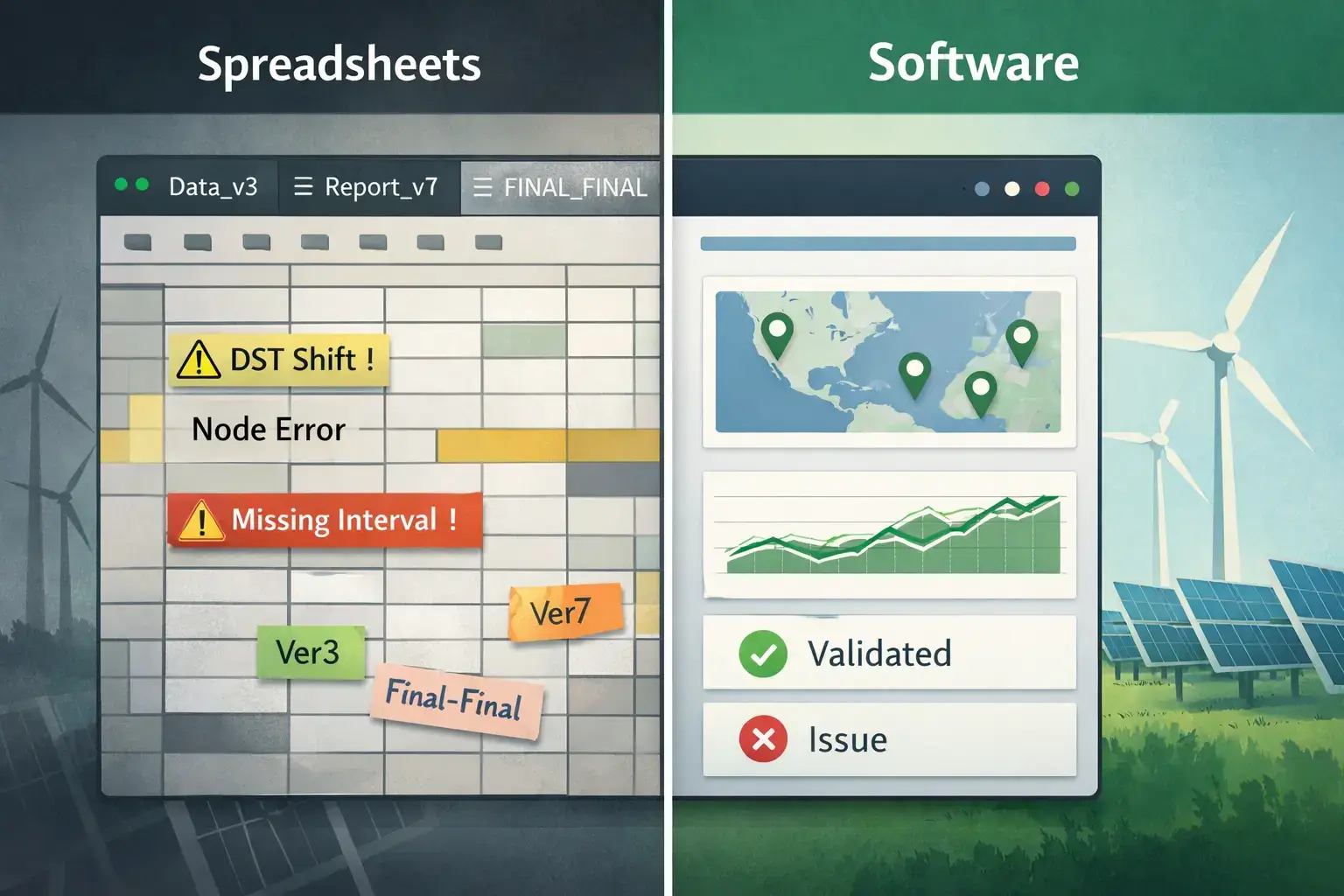
Data fragmentation across spreadsheets and systems
To navigate this complexity, companies must adopt a structured approach to renewable energy asset management. Tracking the right metrics enables better decision-making, improves operational efficiency, and ensures alignment across finance, sustainability, and leadership teams.
Why Metrics Matter in Renewable Energy Asset Management
Renewable energy assets are long-term investments, often spanning 10–20 years. However, many decisions are made before assets are operational, based on forecasts and assumptions. Once assets “go live,” actual performance inevitably diverges from expectations.
This is where renewable energy asset management becomes essential.
Effective asset management requires:
Continuous tracking across the asset lifecycle
Real time monitoring of performance and market conditions
Transparent reporting to stakeholders
Without these capabilities, organizations risk being reactive, attempting to explain performance after the fact rather than actively managing it.
Strong renewable energy asset management transforms raw data into actionable insights, helping organizations maintain asset performance standards and ensure their investments remain cost effective over time.
1. Actual vs. Forecasted Generation
What it is
In renewable energy asset management, this metric compares actual energy production from renewable energy assets to modeled expectations, such as P50 forecasts.
Why it matters
Forecasts assume average conditions, but real-world energy production varies due to weather, equipment performance, and environmental factors. For example, wind turbines may underperform in low-wind conditions or exceed expectations during strong seasonal patterns.
What to monitor
Seasonal production trends
Persistent underperformance
Long-term efficiency changes
Tracking these matrics helps ensure asset performance aligns with expectations and identifies issues early in the asset lifecycle.
2. Market Price vs. Expected Price
What it is
This metric measures the difference between forecasted and actual wholesale energy prices.
Why it matters
In the energy industry, market price volatility is one of the biggest drivers of financial outcomes. Even if energy production meets expectations, fluctuations in price can significantly impact revenue.
Strong renewable energy asset management requires understanding how market conditions affect asset performance and financial returns.
3. Settlement Accuracy and Invoice Validation
What it is
This involves verifying that invoices accurately reflect contract terms, energy production, and market pricing.
Why it matters
Errors in settlement statements are common and can undermine cost effective operations. Inaccurate invoices can distort financial reporting and erode trust.
What to monitor
Timestamp mismatches
Incorrect market prices
Settlement logic that differs from the contract
Discrepancies between contract terms and actual data
Accurate validation is a cornerstone of renewable energy asset management and supports financial transparency.
Basis Risk (Location-Based Price Differences)
What it is
Basis risk is the difference between the price at the asset’s location and the price at the settlement point.
Why it matters
Transmission congestion can reduce the value of energy production, even when market prices are high. This is particularly relevant for geographically dispersed renewable energy assets.
What to monitor
Node vs. hub price differences
Frequency of price divergence
Financial impact on contracts
Managing basis risk is essential for maintaining cost effective performance across a portfolio and is a critical component of renewable energy asset management.
5. Asset Availability and Performance Reliability
What it is
This metric evaluates how consistently renewable energy assets are operational and producing energy.
Why it matters
Operational issues directly affect energy production and revenue. For example, downtime in wind turbines or curtailment events can significantly reduce output.
What to monitor
Mechanical availability
Outage frequency and timing
Production against a benchmark quantity
Tracking this metric helps improve operational efficiency, protect asset performance, and identify issues that may lead to liquidated damages for the buyer.
6. Financial Performance vs. Budget
What it is
This compares actual financial results with internal forecasts and budgets.
Why it matters
Organizations rely on accurate financial projections to make strategic decisions. Variances (if not properly managed) can impact planning and stakeholder confidence.
What to monitor
Monthly and quarterly variance
Budget deviations
Updated forecasts
Tracking this metric helps keep renewable energy asset management aligned with expectations and supports more accurate budgeting as actual performance and market conditions change.
7. Portfolio-Level Performance Insights
What it is
This roles up the above-mentioned, project level metrics into a comprehensive view of performance across all renewable energy assets.
Why it matters
Individual asset performance doesn’t reflect the full picture. Portfolio-level insights reveal trends, risks, and opportunities across the entire asset base.
What to monitor
Regional performance trends
Asset diversification
Portfolio-wide risk exposure
Centralizing data reduces reliance on manual processes and improves asset management outcomes by increasing “speed to insight.”
Turning Raw Data into Action
Transforming raw data into meaningful results is the cornerstone of effective renewable energy asset management, as tracking metrics only yields value when it leads to decisive action. By translating complex performance data into clear, actionable insights, managers can bridge the gap between technical teams and leadership, fostering internal alignment and building organizational trust.
Atechnology-driven approach also allows for proactive decision-making; by monitoring assets in real time and adjusting forecasts as conditions evolve, teams can move away from reactive fixes toward strategic agility. Furthermore, early detection of performance gaps, invoice discrepancies, and operational inefficiencies minimizes financial risk before it scales.
Ultimately, these insights serve as a bridge to external stakeholders, strengthening partner relationships with developers and operators through transparent, data-backed collaboration that ensures superior long-term outcomes and more effective renewable energy asset management.
PPA Performance and Risk Assessment
Pressure-test performance visibility, variance explainability, and cross-functional alignment across finance, sustainability, and energy with this 5-minute assessment.







![[Report] Help Stops at Signing: Why You Need Purpose-Built PPA Management Software](https://verse.inc/wp-content/uploads/2026/04/26q2-verdantix-report.webp)